
Business travel costs are entering a different phase. Following sharp fluctuations in recent years and the energy shock in early 2026, the market is stabilizing, with price increases expected to slow in 2027. Stability, however, does not mean lower prices—only more moderate increases. These are the findings of the 2027 Global Business Travel Forecast, prepared by GBTA and ALTOUR, one of the world’s largest travel management networks, which Aerotravel has been part of since 2019.
Demand for business travel remains strong because companies view trips as an essential tool for growth rather than an optional expense. For travel budget managers, the challenge is understanding how each component of a business trip or corporate event will change in price so they can budget as accurately as possible for 2027.

A Study Based on Actual Business Travel Spending
The study was conducted by GBTA, the global association for the business travel and corporate events industry, in partnership with ALTOUR, a travel management network present in more than 90 countries. ALTOUR’s data was analyzed using models developed by Avrio Institute, an economic research and forecasting firm.
The analysis draws on prices actually paid by ALTOUR corporate clients over the past 18 months. The data was anonymized and combined with GBTA research and other publicly available economic indicators. Forecasts were calculated separately by region and expense category, then reviewed by specialists from ALTOUR, GBTA, and Avrio Institute against recent market developments.
The report covers four expense categories: air travel, accommodations, ground transportation, and corporate events. Its figures describe broad market trends; each company’s actual business travel costs will also depend on destinations, booking lead times, and negotiated supplier agreements.
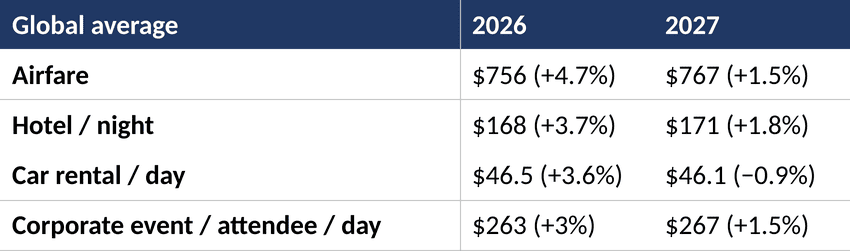
The Forecast at a Glance
Factors Shaping Business Travel Costs
To understand business travel costs, the report makes a useful distinction between temporary pressures and longer-term forces. Fuel is the main temporary factor: after jet fuel climbed above $230 per barrel in the first part of 2026, prices began to fall, and the report’s authors expect a gradual easing in 2027.
Long-term factors include labor costs in aviation, hospitality, and transportation, many of which are determined by multiyear agreements and statutory minimum wages. Other pressures include delays in new aircraft deliveries and European Union requirements for airlines to use increasing proportions of sustainable aviation fuel.
These forces help explain why business travel costs are not returning to their 2025 levels. Exchange rates introduce another variable: the report’s figures are expressed in U.S. dollars, and its authors expect the dollar to weaken in 2027.
Air Travel: The Largest Price Swings
Airfares posted the largest increases among business travel cost categories in 2026, but growth is expected to slow considerably in 2027. In EMEA (Europe, the Middle East, and Africa), which includes Romania, Economy Class fares are projected to increase by 7.2% in 2026 and 1.8% in 2027. For premium cabins—Premium Economy, Business, and First Class—the rate is expected to fall from 7.8% to 1.5%.

Two structural problems affecting business travel costs will nevertheless keep fares elevated: a shortfall of 3,170 aircraft and a need for approximately 660,000 pilots by 2044. Neither can be resolved quickly.
ALTOUR’s analysis also highlights the importance of travel policies. More business trips were booked in less expensive cabin classes; without this shift, the average global ticket price in 2026 would have been $787 instead of $756.
Corporate travel programs are governed by internal policies and managed through specialist travel management agencies, which already helps companies exercise tighter cost control.
Hotels: New Supply Moderates Room Rates
Accommodation costs are expected to follow a more balanced path than airfares. A record pipeline of hotel projects, representing around 2.4 million rooms worldwide, is likely to hold rate increases below the levels that demand alone would support.

Regional differences remain significant. In Latin America, hotel rates are increasing by 9.5% in 2026, compared with just 0.6% in EMEA. For 2027, the report anticipates stable hotel rates in EMEA. This divergence reinforces the need to build travel budgets around individual market conditions rather than global averages.
Ground Transportation: The Most Predictable Category
Car rental is expected to remain the most stable component of business travel costs. Fleets have recovered, competition is keeping prices in check, and rates are forecast to decline slightly in 2027, including in EMEA. Tariffs remain an important variable, however, because they may raise vehicle prices and put upward pressure on rental rates in North America and Europe.
Corporate Events: The Greatest Room for Choice
Demand for events is expected to increase slightly, with budgets following a similar pattern. This growth will be driven primarily by corporate clients choosing to spend more on larger, more complex events featuring additional activities and higher-quality services.

What the Forecast Means for Your Travel Program
According to ALTOUR’s analysis, discipline will be the watchword for 2027. GBTA CEO Suzanne Neufang emphasizes that forecasts by spending category will matter more than overall inflation, while regional differences will matter more than global averages. For companies preparing their business travel budgets, the practical recommendations are:
- Analyze spending by category, route, destination, and event type. A uniform, across-the-board approach misses opportunities to save.
- Negotiate rates separately for each region. Global averages conceal substantial differences between markets.
- Build budgets using current rates. A budget based on 2025 prices will not cover actual airfare expenses, particularly for companies with frequent long-haul flights or travel to the Middle East.
- Use the forecast as a benchmark, not a fixed figure. Another closure of the Strait of Hormuz, a sudden fuel price spike, aircraft delivery delays, or currency fluctuations could push business travel costs above projected levels.
Build Your 2027 Travel Budget with Aerotravel
The Aerotravel team can help translate the report’s findings into a practical plan for 2027: budgets organized by expense category and destination, tripartite agreements with service providers, and an updated corporate travel policy. Contact us HERE to review your company’s travel program together.