
International tourism ended the first half of 2026 in positive territory, recording 690 million international arrivals—3 million more than in the same period last year. The figures come from the latest World Tourism Barometer, published by UN Tourism in September 2026, and send an important message to companies planning travel budgets: despite higher fuel prices caused by two regional conflicts, people have continued to travel.
Growth is slower than anticipated at the start of the year, but the trend remains positive. For companies focused on business travel planning, the challenge is to manage costs effectively in a market where prices remain volatile.
For business travel planning, an agency specializing in business travel can help optimize budgets by monitoring fares, identifying suitable routes, and recommending when to book. This allows companies to make better-informed decisions for the final quarter of 2026 and throughout 2027.
A First Half That Tested the Market’s Resilience
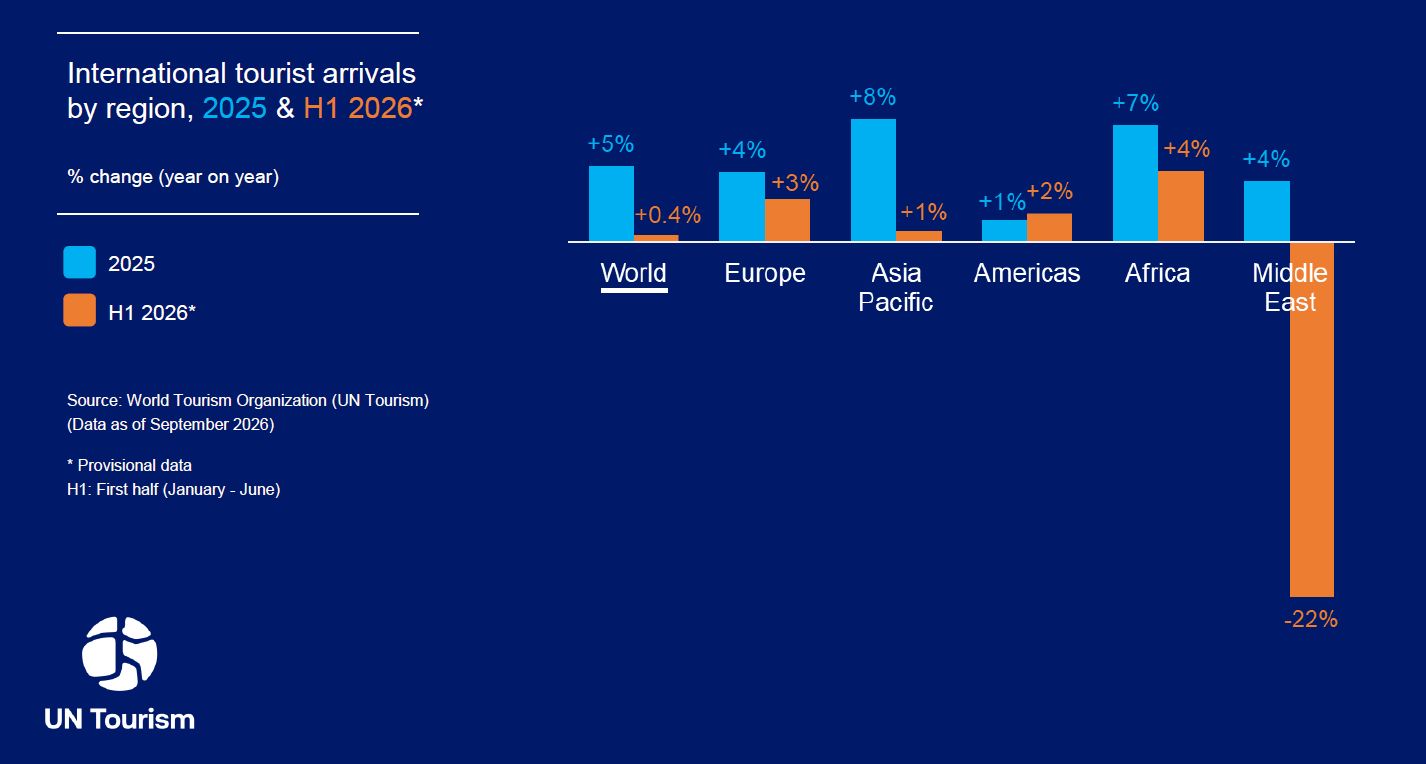
International arrivals rose 2% in the first quarter of 2026, while the second quarter ended with a 1% decline. April’s 3% drop had two explanations: Easter fell in April this year, and the conflict in the Middle East disrupted air traffic. Arrivals declined another 3% in June, largely due to results in Western Europe (down 6%), where a heat wave discouraged some travelers.
For business travel planning, the regional figures for the first half of 2026 show the following:
Europe remains one of the world’s most stable regions. International arrivals have risen in each of the past several years and now stand 11% above pre-pandemic levels.
Air connectivity is another important consideration in business travel planning for companies organizing business trips. UN Tourism monitored daily flights by seven Middle Eastern airlines: Air Arabia, Emirates, Etihad, flydubai, Gulf Air, Kuwait Airways, and Qatar Airways. On March 1, their combined number of flights was 99% below the pre-conflict average. After the ceasefire was announced, traffic recovered gradually:
- April 2: 48% below the pre-conflict average.
- June 5: 21% below.
- July 3: 1% below.
- August 22: 4% above.
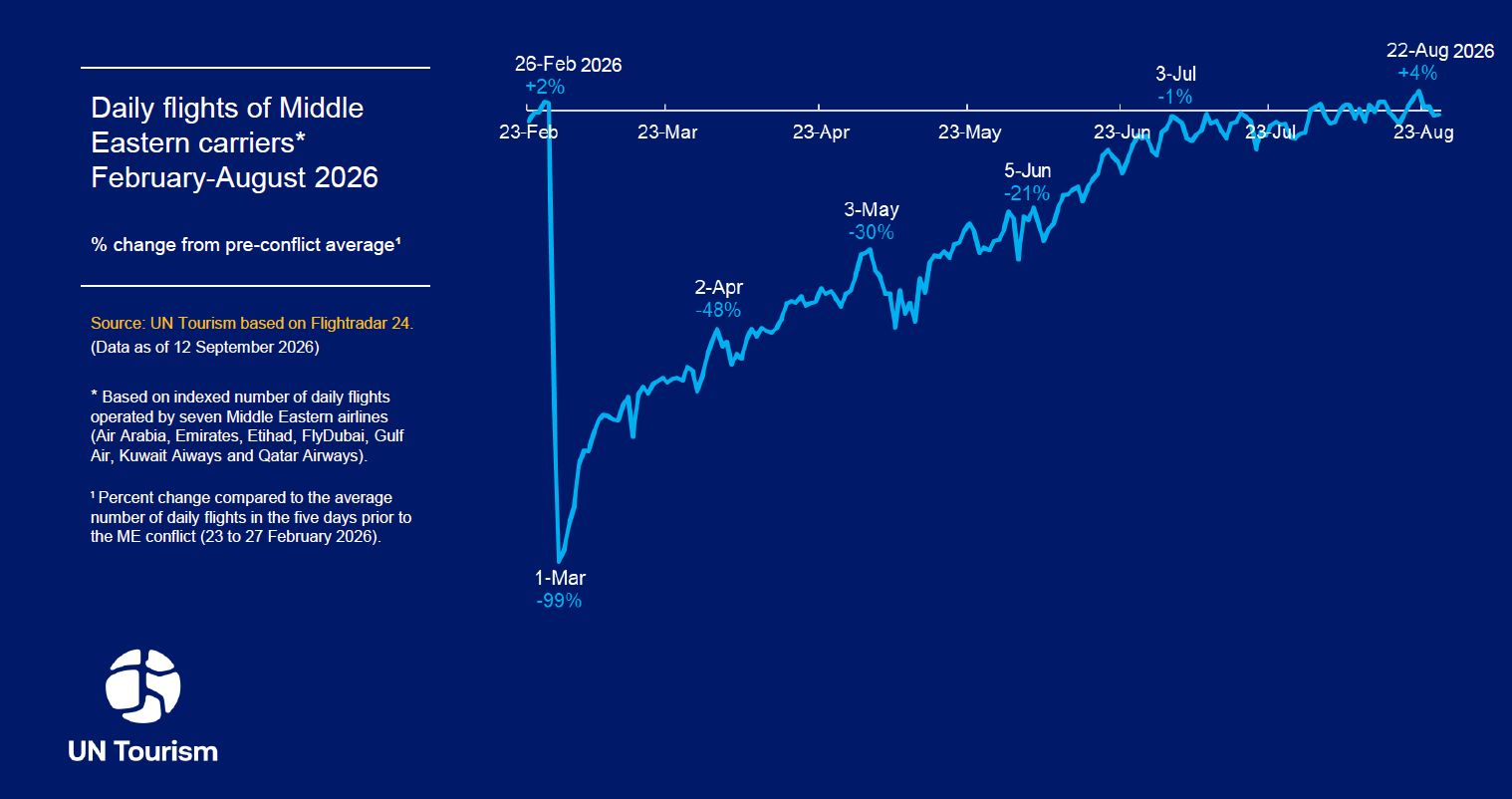
The figures show that the Gulf’s major airport hubs have recovered their pre-conflict activity levels, even as the international environment remains uncertain. Neither companies nor travel suppliers can control events of this kind, but careful planning can limit their impact. Working with a travel management agency, you can identify alternative routes and backup arrangements in advance, helping minimize disruptions to your company’s operations.
Romania Appears in Two Global Rankings
The UN Tourism Barometer includes Romania in two worldwide rankings for the first half of 2026: international tourism receipts from visitors to Romania and spending by Romanian residents traveling abroad.
International tourism receipts: +9%. This indicator measures spending in Romania by foreign visitors. In the first half of 2026, Romania ranked among the world’s 20 destinations with the strongest growth in tourism receipts and was the only Central or Eastern European country on the list.
Business travel accounts for a significant share of these receipts. According to Romania’s National Institute of Statistics (INS), as reported by Agerpres, 51.8% of foreign tourists staying in hotels in the first quarter of 2026 visited Romania for business. Their spending accounted for 53.8% of total spending by foreign tourists, or RON 800.7 million.
Business trips therefore represented more than half of spending by the foreign tourists covered by these statistics. However, INS does not specify how much they contributed to the 9% increase in international tourism receipts.
Spending on outbound travel: +18%. This indicator measures spending outside Romania by Romanian residents. Romania ranks seventh worldwide among markets with the fastest growth in international tourism spending, ahead of Japan, Spain, and Greece.
For business travel planning, the conclusion supported by these figures is that, despite more expensive airfares and geopolitical uncertainty, Romanians continued traveling abroad and allocated larger travel budgets than in the previous year.
Industry Outlook for the Final Months of the Year
UN Tourism experts are moderately optimistic about September–December 2026. Asked how their destinations would perform compared with the same period in 2025, 79% anticipated similar or better results.
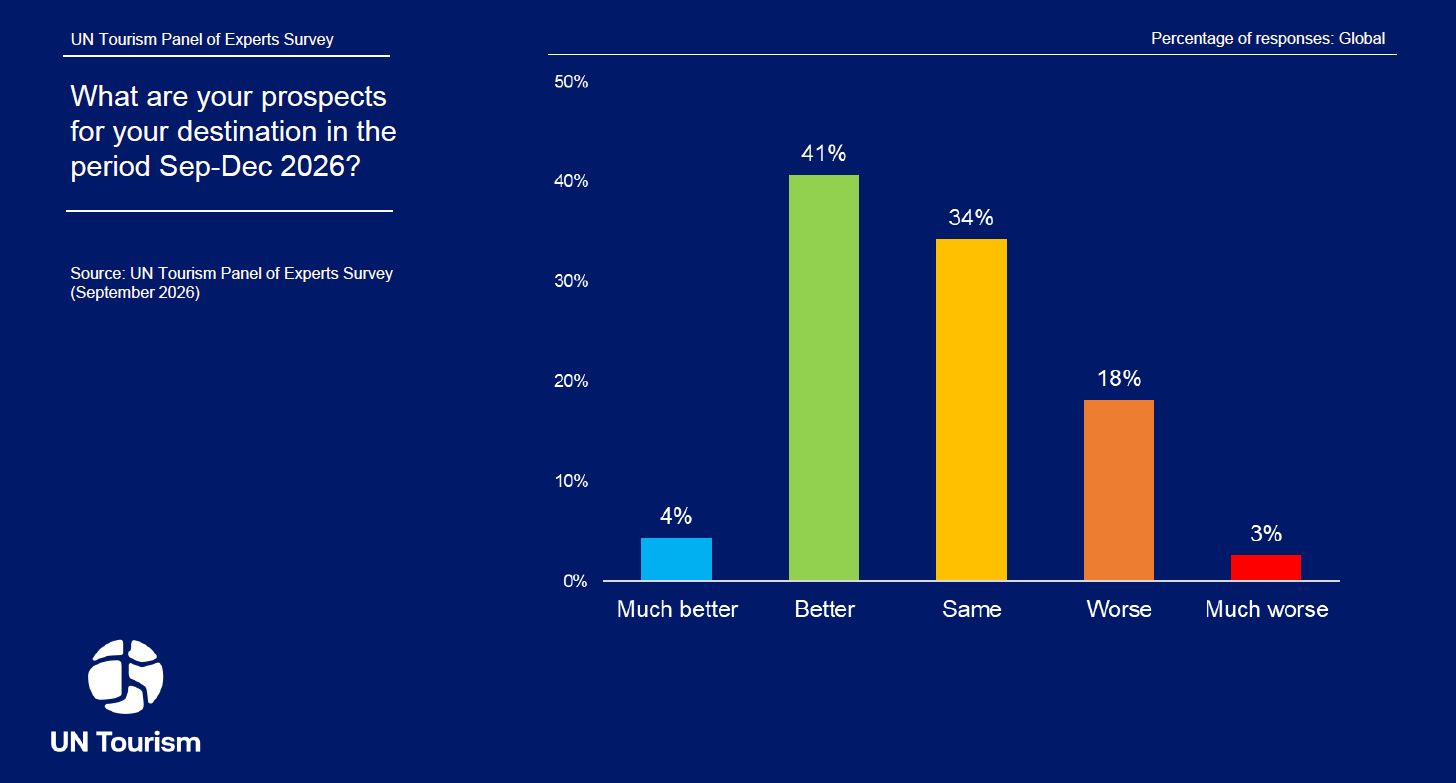
For business travel planning, confidence is even stronger in Europe. Of European experts, 85% expect similar or better outcomes: 5% anticipate much better results, 38% better results, and 42% similar results. None expect much worse performance.
The UN Tourism Confidence Index supports this outlook. A reading of 100 separates positive from negative expectations; the index reached 113 for September–December 2026, up from 105 for May–August. In addition, 77% of experts expect their destinations to receive more international tourists in 2026 than in 2025, compared with 71% in the May survey.
For the full year, UN Tourism now forecasts international arrival growth of 1%–2%, down from its January projection of 3%–4%. The revision reflects a more difficult year than anticipated, not a reversal of the broader trend. The market continues to grow, and the final outcome will depend on how long the conflicts last and how they affect oil prices and inflation.
Costs: The Main Challenge in 2026
In UN Tourism’s ranking of challenges facing international tourism in 2026, based on expert responses, economic factors rank ahead of geopolitical ones.
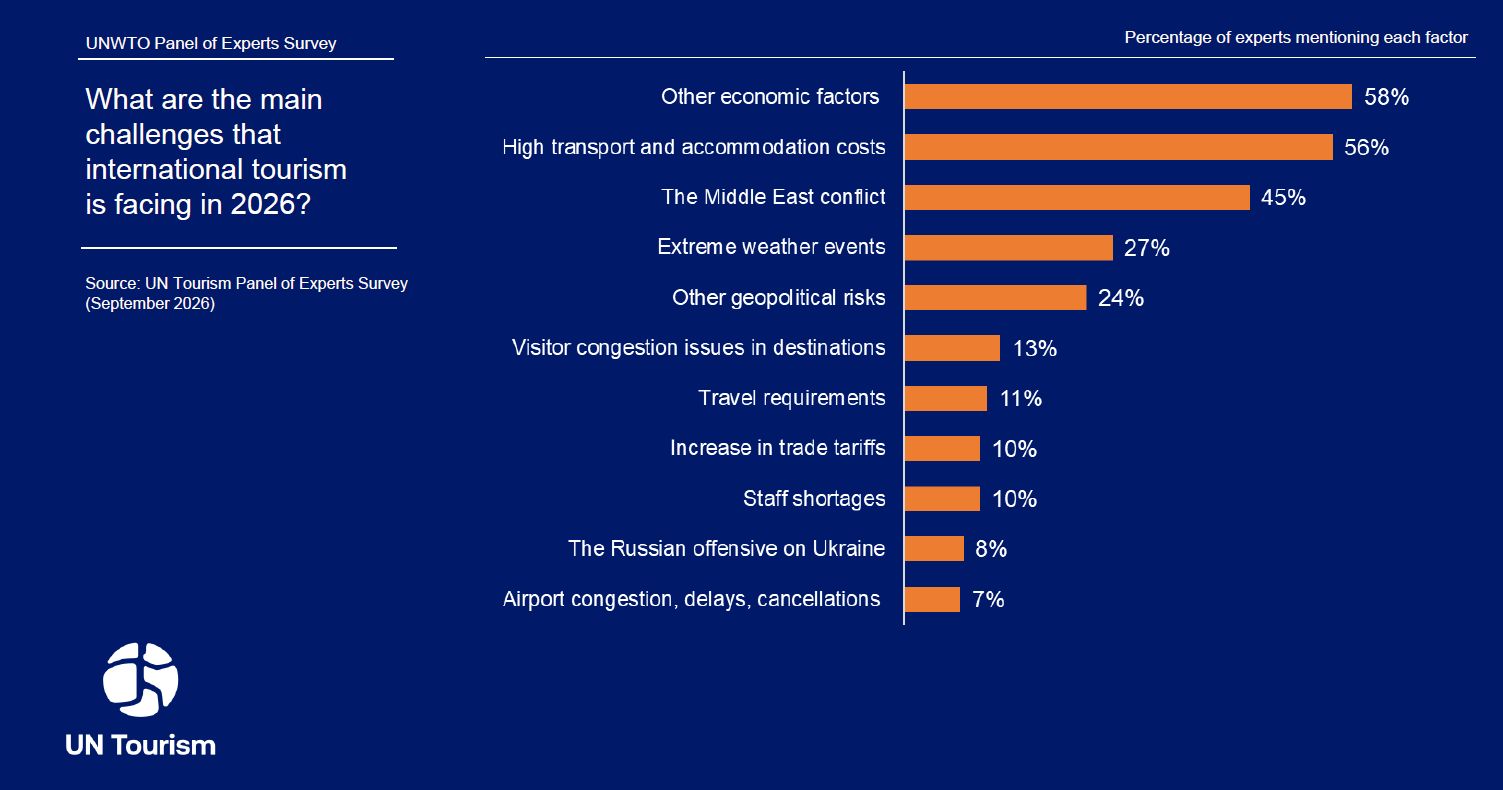
Destination congestion (13%), travel conditions (11%), and airport delays or cancellations (7%) were cited less frequently. For companies, the message is clear: the main challenge concerns cost and planning rather than access to destinations.
Fuel prices explain much of this pressure. Jet fuel and Brent crude experienced substantial swings in 2026. Falling prices during the summer showed that the market can ease quickly, but renewed increases in August and September confirmed that volatility remains high.
Meanwhile, tourism prices have risen faster than overall prices for several years. In 2025, tourism inflation, encompassing hotels, restaurants, and transportation, reached 6.1%, compared with global headline inflation of 4.1%.
Value, Proximity, and Technology: What Travelers Want in 2026
Consumer trends identified by the experts cited by UN Tourism point toward travelers who are increasingly budget-conscious.
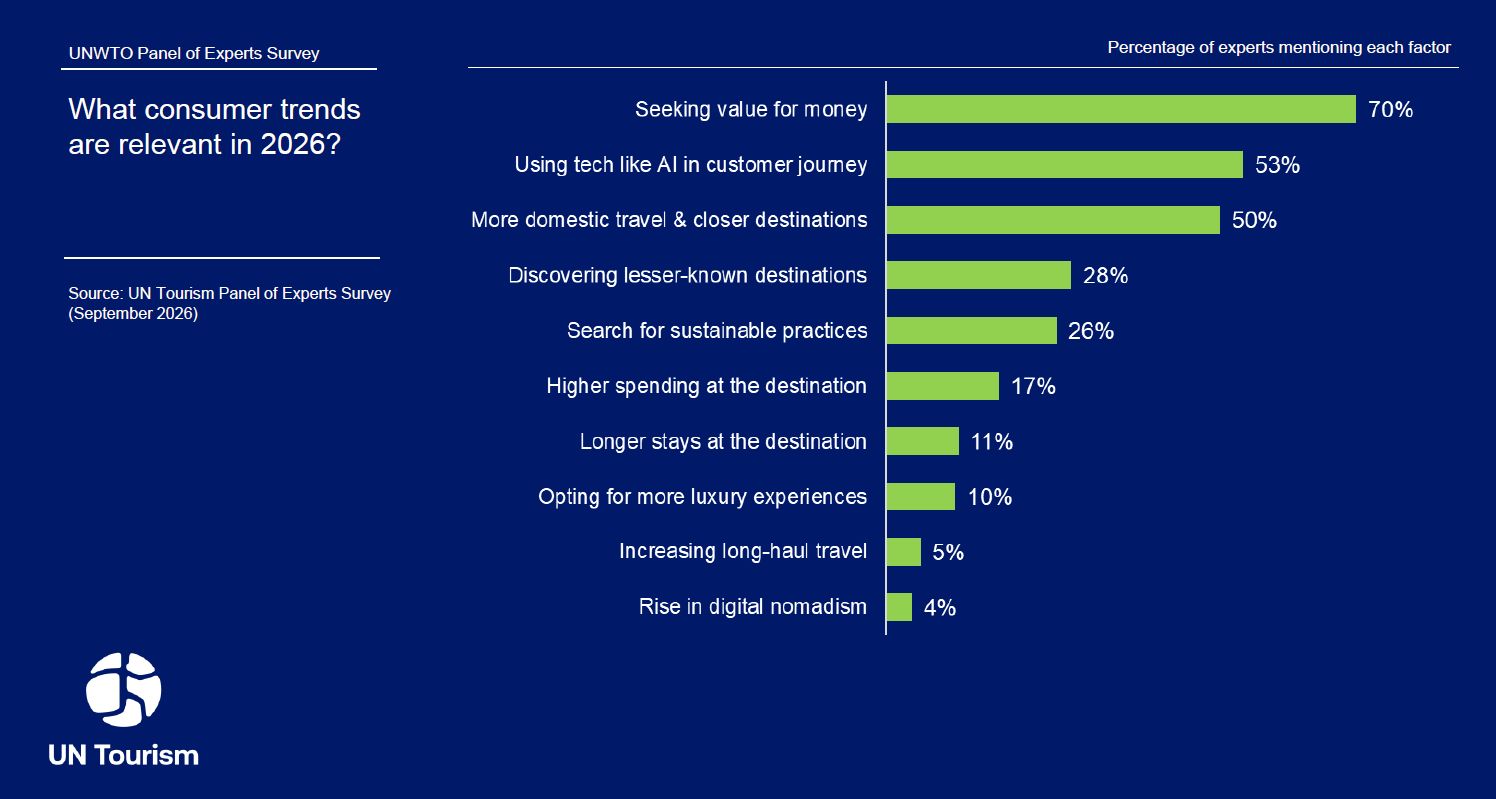
At the other end of the spectrum, only 5% of experts report an increase in long-haul travel, while 10% observe a stronger preference for luxury experiences.
These business travel planning trends have practical implications for companies. Value for money should be assessed against the total cost of travel services, not just the airfare. Baggage, booking-change conditions, accommodations, transfers, and the time employees spend traveling all belong in the calculation.
For business travel planning, a preference for nearby destinations may favor meetings and events held in Europe, where demand is stable and air connections are plentiful. Lesser-known destinations can provide alternatives for corporate events, particularly when major cities are crowded and expensive.
In business travel planning, technology makes booking and expense reporting simpler and faster, provided it is complemented by assistance from travel consultants when plans change.
Monitor the Lufthansa fleet rollout, as the technology will be installed gradually.
How Companies Can Plan Business Travel for 2026 and 2027
For business travel planning, the UN Tourism figures point to a clear conclusion: demand remains solid while costs continue to fluctuate. The answer is not necessarily to reduce business trips, but to organize them more carefully.
September–December 2026: Book Early and Stay Flexible
In business travel planning, the final quarter is traditionally busy with business meetings, conferences, and year-end events. With 79% of experts expecting similar or better results and jet fuel prices having risen again in September, booking flights and hotels early is increasingly important for cost control.
For routes crossing sensitive regions, tickets with flexible change conditions offer additional protection that may justify a higher fare.
The 2027 Budget: Multiple Scenarios, Not One Estimate
The GBTA–ALTOUR forecast for 2027 brings encouraging news: in EMEA, which includes Romania, growth in Economy Class airfares is expected to slow from 7.2% in 2026 to 1.8% in 2027, while hotel rates remain stable.
For business travel planning, fuel price volatility in 2026 shows why travel budgets need a contingency allowance for air transportation. It also makes sense to prepare alternative scenarios that can be revised during the year as the market changes.
The Market Is Still Growing. Planning Makes the Difference.
The first half of 2026 confirmed that international tourism continues to grow despite difficult circumstances. Europe remains stable, expert confidence is higher for the end of the year, and Romania ranks among the better-performing markets.
In a market marked by fluctuating prices, companies that plan trips and budgets ahead can control costs more effectively and make better-informed decisions.
As part of the global ALTOUR network, the Aerotravel team can help turn these figures into a practical plan for the final quarter of 2026 and for 2027. From corporate travel policies and category-based budgets to bookings and assistance for employees on the road, we support every aspect of your company’s travel program. Contact us HERE to discuss your organization’s needs.